
Belarusian Museum Relocates from Leimen to Vilnius After Years in Storage
After years in storage, the Belarusian Museum in Leimen has found a new home in Vilnius, where its unique collection will once again be accessible to the public.
The Belarusian Museum in Leimen (Baden-Württemberg) is being relocated to Vilnius, Lithuania. After the museum had remained closed for years, a solution was finally found following lengthy discussions between the city of Leimen and the Belarusian community RAZAM e.V.: the exhibits will in future be made accessible to the public at the Belarusian Ivan Łuckievič Museum in Vilnius, Lithuania.
The history of the museum
The Belarusian Museum in Leimen was founded in 1982 by the activist and writer Jury Popka (Juri Popko, 1912–1990). Born in a village near Pružany, Popka wrote for Belarusian-language newspapers. His family was affected by Soviet repression; several relatives were deported to Siberia. After the German invasion of the Soviet Union, Popka initially worked in the civil administration before being brought to Germany as part of the wartime economy, where he worked in industry under harsh conditions.

Factory labour severely damaged Popka’s health, and after the war he had to be treated in several hospitals. Returning to Belarus was not an option for him, as he feared political persecution by the Soviet authorities. He therefore spent most of his exile working in the administration of a U.S. military camp.
From 1971 onwards, Popka lived in the city of Leimen and began transforming his private apartment (Goethestraße 1) into a museum of Belarusian artefacts. He received significant support from the Belarusian rocket scientist Barys Kit (1910–2018), who was also living in exile and supplied him with Belarusian émigré literature from the United States. Kit, who enjoyed a high reputation as a professor of mathematics at the University of Maryland, also drew the attention of Leimen’s mayor to the museum. As a result, the Belarusian Museum quickly developed into an officially recognised attraction of the city.
The museum was ceremonially opened in 1982 in the presence of Mayor Herbert Ehrbar (1933–2011). A specially established working group called on Belarusians worldwide to contribute historically significant objects to the exhibition.
The collection included numerous exhibits both from the Belarusian Soviet Socialist Republic (BSSR) and from the global diaspora, including Germany, Poland, the United Kingdom, France, Australia, the United States, Canada and Argentina. On display were books and journals, clothing, photographs, portraits, icons, tableware, as well as various everyday and commemorative objects. Particularly notable were unique manuscripts by prominent authors such as Janka Kupała, Jakub Kołas, Branisłaŭ Taraškievič, Maksim Harecki and Usievaład Ihnatoŭski, as well as numerous works of Belarusian émigré literature.
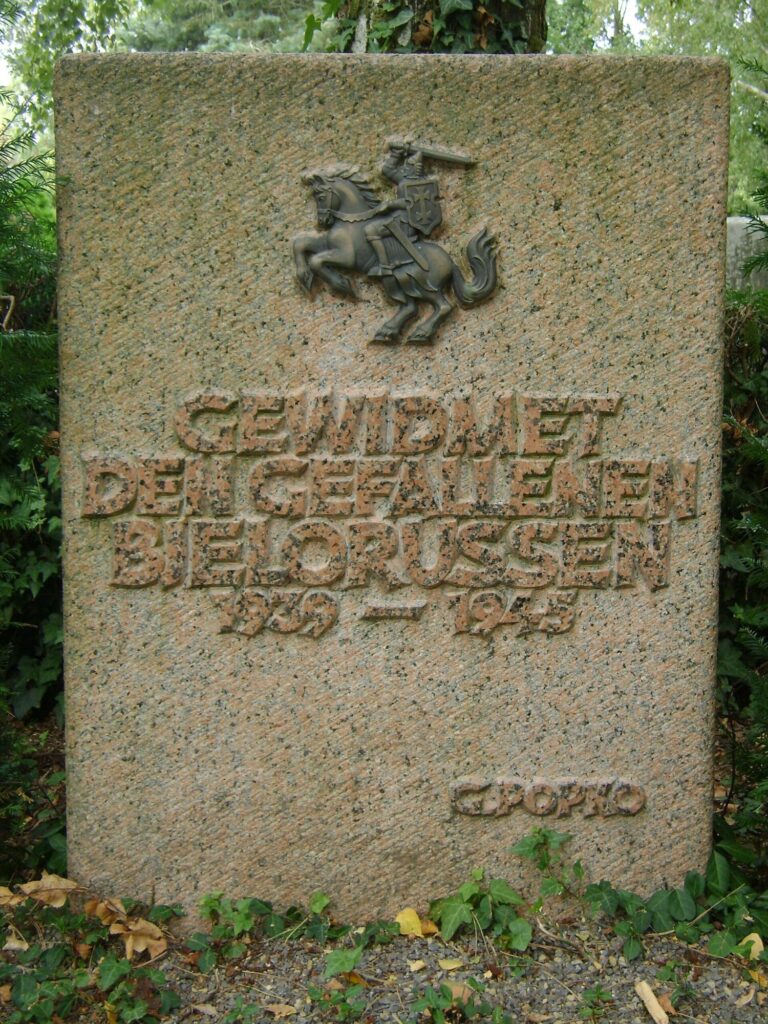
In addition, Popka founded the Institute of Belarusian Cultural Studies in Leimen, which published its own works. In 1987, on his initiative, a monument to Belarusians who had fallen in the Second World War was erected at the Waldfriedhof St. Ilgen. It is now located directly opposite Popka’s grave.
Jury Popka’s legacy
Popka did not live to see the independence of Belarus. He passed away on 29 April 1990. However, his contribution to German-Belarusian relations continued beyond his death.
Barys Kit described his friend Jury Popka as follows:
“I held this man in high regard, a man who carried his homeland in his heart while living far away, collecting and preserving everything that reminded him of it. Perhaps he himself did not expect that to Leimen, to this small Belarusian museum, first a few Belarusian émigrés, enthusiasts of the Belarusian cause and scholars would come—and later even students arriving by the busload, as happened in June 1994. Belarusian boys and girls, young and beautiful, came here to sing their songs (it was the chamber choir of the Minsk Linguistic University) to a town that had given refuge to a true Belarusian.”
Kit himself was awarded the Gold Partnership Medal by Mayor Herbert Ehrbar in 1993 in recognition of his special services to the friendship between the Republic of Belarus and the city of Leimen.
In 1995, a delegation led by Herbert Ehrbar travelled to Navahrudak in Belarus. In cooperation with him, the Leimen association “Hilfe für Weißrussland” delivered vehicles, medicines, medical equipment, hospital and care beds, school furniture, clothing, blankets, toys and baby food to the independent Republic of Belarus in eleven aid convoys between 1995 and 2006. Due to increasing bureaucratic obstacles and obstruction by the regime, these deliveries were discontinued.
The end and relocation of the museum
In 1994, the then Belarusian ambassador to Germany, Dr Piotra Sadoŭski, established a board of trustees to manage Jury Popka’s legacy. However, after his dismissal, the Belarusian embassy under the new authorities showed no interest in the museum.
The exhibition was temporarily accessible at the local museum in St. Ilgen but was closed due to a lack of visitors. The exhibits were subsequently stored for many years in several depots. During this period, unknown persons broke into one of the storage facilities and damaged part of the collection. A significant portion of the exhibits was also destroyed due to water damage.
From January 2026, the remaining items in the collection were repacked at the Leimen city archive by representatives of RAZAM e.V. and transported to the Łuckievič Museum in Vilnius in March.


The relocation of the museum was organised by Alexander Moisseenko (RAZAM e.V.) and Ludvika Kardzis (Ivan Łuckievič Museum), with support from Dmitri Moisseenko, the Krecheuski Foundation, the Koura Initiative and other volunteers who preferred to remain unnamed.

The German-Belarusian Society warmly congratulates all those involved on the successful relocation of the museum to Vilnius. We are pleased and grateful that the legacy of Jury Popka has found a new home where it can once again be made accessible to the public.
We also express our sincere gratitude to the City of Leimen, to RAZAM e.V., and in particular to Alexander Moisseenko for their dedicated commitment and for making the relocation of the museum possible. Their efforts have been instrumental in preserving and revitalising this important part of Belarusian cultural heritage.